Not every enquiry that lands in your inbox deserves the same reply. But if you’re like most small business owners, you’re treating them like they do.
The “just checking prices” message gets the same 20-minute, thoughtful response as the client who’s ready to book this week. That’s not generous, it’s expensive. Every hour you spend crafting a careful reply to a poor-fit lead is an hour you didn’t spend on the enquiry that was actually going to close.
Here’s what that costs you over time. Spending equal effort on every lead, including the poor-fit ones, the low-urgency ones, the vague ones, and the ones you can’t even service, quietly drains hours you don’t have. It doesn’t feel like a crisis in the moment. It feels like being responsive. But add it up over a month, and you’ve spent real time on conversations that were never going anywhere.
This is where knowing how to qualify a sales lead changes everything. It’s not about being colder to prospects, it’s about being faster and clearer with the ones who are actually a fit, so nobody wastes time on a conversation that was never going to convert.
Pro-Tip: Before you build any qualification process, pull your last 15 enquiries and sort them into “converted,” “went nowhere,” and “still unclear.” You’ll usually spot the pattern in under five minutes, and that pattern is exactly what your qualification criteria should be built around.
Learning how to qualify a sales lead in under a minute is the difference between a business that runs on reaction and one that runs on priorities. Below is a five-factor method that does exactly that, and it’s built to work whether you’re screening leads by hand or letting AI lead scoring handle the first pass.
If you haven’t set up a consistent way to capture and track enquiries yet, it’s worth reading our lead management process first, since qualification only works once leads are landing somewhere you can actually see them.
Table of Contents
The Problem: Treating Every Lead the Same
Picture this. A “just checking prices” email lands in your inbox at 2pm. You spend 20 minutes writing a thoughtful, personalized reply. That same afternoon, a ready-to-book client emails too, and gets the exact same 20-minute treatment.
That’s the trap. Treating every enquiry as equally urgent forces you to spend time on unqualified leads at the expense of the ones actually ready to buy. It doesn’t feel like a mistake in the moment, it feels like good service. But it’s costing you more than you think.
Do the math on your own inbox. If you’re spending 20 minutes on each of 15 enquiries a week, and even half of those are poor-fit, unclear, or nowhere near ready, that’s 2.5 hours a week spent on conversations that were never going to convert. Over a month, that’s 10 hours, an entire working day, gone to leads that didn’t need that level of effort.

This is exactly why learning how to qualify a lead in sales matters more than most small business owners realize. It’s not a “nice to have” process for bigger teams with dedicated sales staff. It’s the difference between reacting to whatever lands in your inbox and actually controlling where your time goes.
Pro-Tip: Track your reply times for one week without changing anything yet. Just note how long each response took and whether that lead converted. Most owners are shocked to find their fastest, most detailed replies often went to the leads that never closed.
If enquiries are still landing in scattered places, your email, a contact form, a DM, a voicemail, qualification won’t fix that first. Get getting every enquiry into one place first in place before you try to sort the good ones from the rest.
The Manual Process Today: Why Gut-Feel Qualification Fails
Most small business owners qualify leads by gut feeling alone. It’s inconsistent, it’s slow, and it breaks down the moment your enquiry volume increases.
Gut-feel qualification usually shows up in three ways, and you’ve probably done all three this month:
- Replying fastest to whoever emailed last, not whoever actually needs a reply most
- Judging fit by tone alone, a friendly-sounding email gets prioritized over a blunt one, regardless of actual fit
- Ignoring quiet red flags, like a budget mismatch buried in the third sentence, because you’re focused on sounding helpful, not screening
None of these are lead qualification criteria. They’re habits, and habits don’t scale.

Here’s where it really falls apart. At two or three enquiries a week, gut feeling works fine, you have the mental bandwidth to weigh each one. But once you cross 10 enquiries a week, that same instinct starts making decisions under pressure instead of judgment, and pressure decisions default to whoever’s loudest or most recent, not whoever’s the best fit.
Pro-Tip: If you’re already past 10 enquiries a week and still deciding case by case, that’s not a discipline problem, it’s a system gap. The fix isn’t replying faster or working longer hours, it’s building one repeatable framework you run every enquiry through, so the decision gets made the same way every time.
A repeatable framework fixes this. Not more hustle, not faster typing, not answering your phone during dinner. The five-factor method below replaces gut feeling with a structure you can actually trust, one that works the same on your busiest week as it does on your slowest.
How to Qualify a Sales Lead: The Five-Factor Method
Quick answer: To qualify a sales lead, score the enquiry against five lead qualification criteria — fit, urgency, budget, need, and location — then act on the result in under a minute. No guesswork, no gut feeling, just a repeatable check you set once and reuse every time.
Here’s the full breakdown:
| Factor | What to Check | Red Flag |
|---|---|---|
| Fit | Does this match what you actually sell? | Mismatched industry or scope |
| Urgency | Is a timeline stated or implied? | Vague “someday” language |
| Budget | Is a price range mentioned or inferable? | Asks for free work upfront |
| Need | Is a clear problem stated? | No specific problem, just browsing |
| Location | Is it inside your serviceable area or timezone? | Outside your service radius |
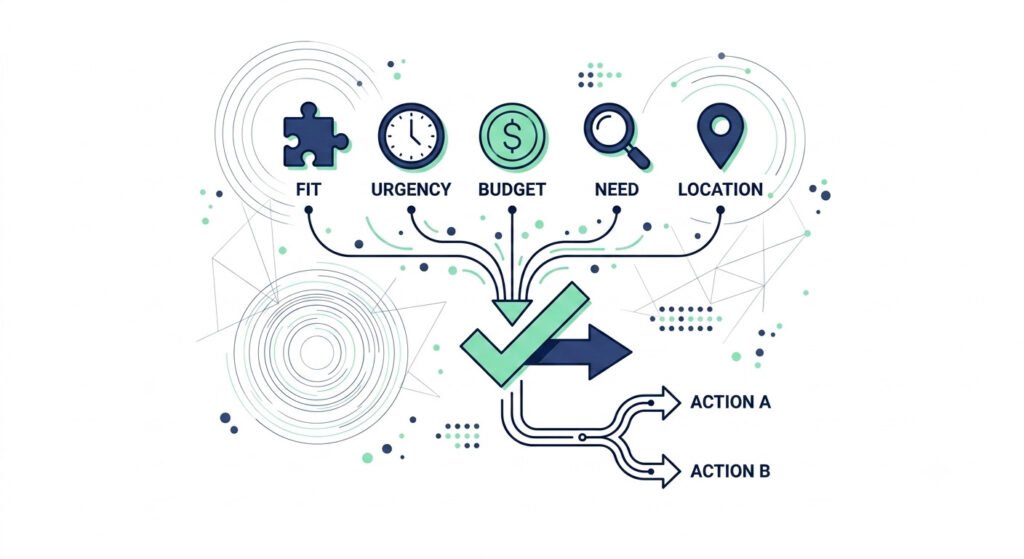
That table is your entire set of lead qualification criteria. You’re not judging tone, guessing intent, or replying based on who emailed most recently. You’re checking five specific things, and each one either checks out or raises a flag.
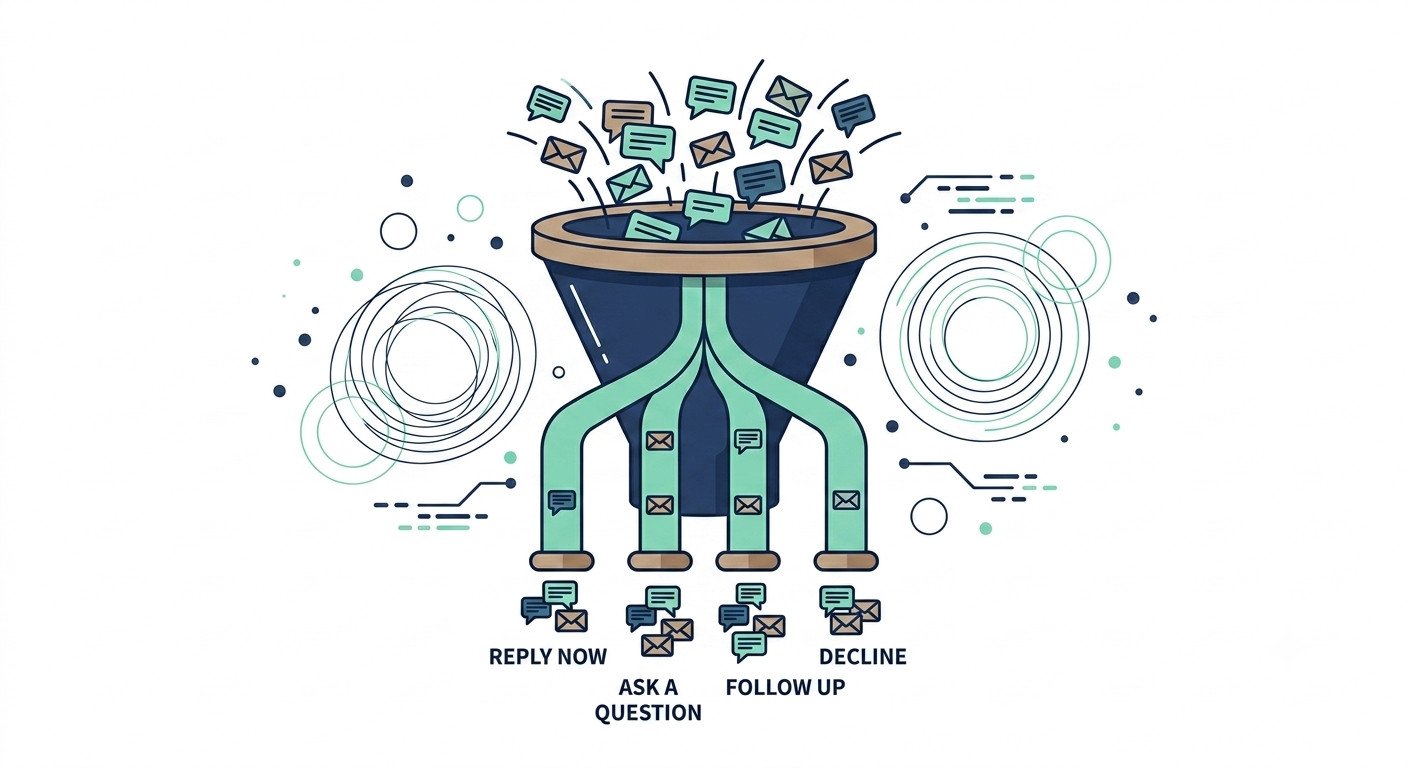
Here’s how to score it fast. Give each factor a simple check or an X. Five checks means reply now. Three or four checks means one factor needs a quick clarifying question. One or two checks means the lead probably isn’t ready, so it goes into follow-up. Zero or one check means it’s not a fit, and a polite decline saves you both time.
Pro-Tip: Once you’ve scored 20 or 30 leads manually and trust the framework, this is exactly the kind of repetitive decision automated lead qualification can handle for you. Feed the same five factors into an AI text classifier that pre-tags each inbound enquiry, so by the time you open your inbox, you already know which ones need your attention first.
This system scales in a way gut feeling never could. Whether you get five enquiries a week or fifty, the five factors don’t change, only the volume does, and that’s exactly why it holds up under pressure instead of falling apart.
Reply Now, Ask a Question, Follow Up, or Decline: Making the Call
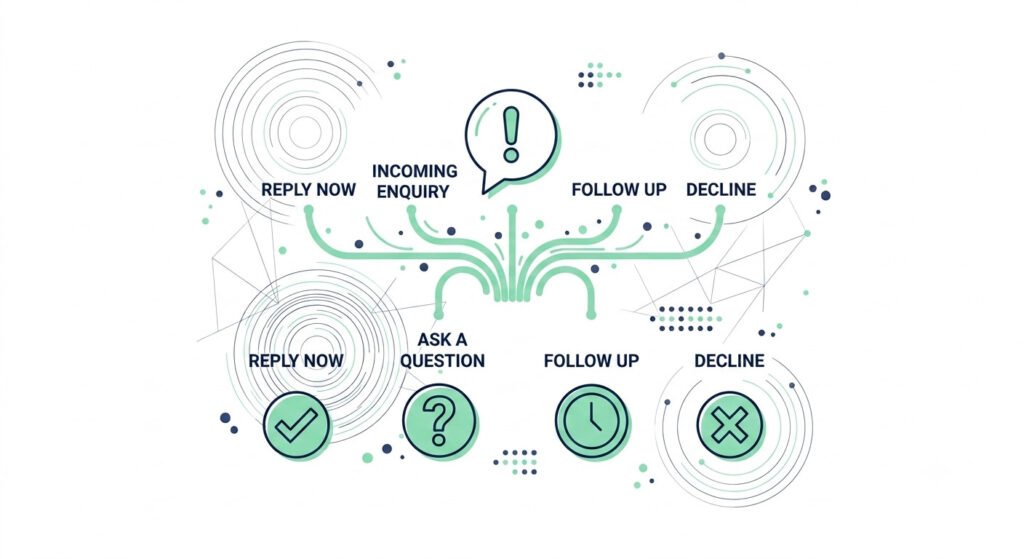
Once you’ve scored a lead against the five factors, the next action is already decided for you. A lead scoring high on all five gets an immediate reply, a lead missing one or two factors gets one qualifying question, and a lead missing three or more gets placed into follow-up or declined politely.
Here’s the exact decision rule:
- 5 out of 5 checks: reply now, this lead is ready
- 3 to 4 out of 5 checks: ask one qualifying question, then reassess
- 1 to 2 out of 5 checks: move to a follow-up sequence, not ready yet
- 0 to 1 out of 5 checks: decline politely, this isn’t a fit
That’s it. No second-guessing, no rereading the email three times trying to decide how you feel about it.
Lead Qualification Questions to Ask a Borderline Lead
The middle category, 3 to 4 checks, is where lead qualification questions do the real work. Ask one targeted question per missing factor, not a list of five. Here’s what that looks like in practice:
- Missing budget: “What budget range are you working with for this?”
- Missing urgency: “What’s your ideal timeline for getting this started?”
- Missing need: “What specific problem are you hoping to solve?”
- Missing fit: “Can you tell me more about your business and what you’re looking to achieve?”
One question, sent quickly, tells you almost everything the other four factors already confirmed.
Pro-Tip: Save your top three qualifying questions and your polite decline message as templates now, in your email drafts or notes app, ready to copy and personalize in seconds. The goal isn’t a robotic auto-reply, it’s removing the blank-page moment where you waste five minutes deciding how to phrase something you’ll end up writing the same way anyway.
Here’s the part most owners miss. A lead placed into follow-up isn’t handled, it’s just delayed. If that lead doesn’t get a scheduled touchpoint, it goes cold exactly like an unqualified one would. That’s where automating that follow-up step matters, so a “not ready yet” lead doesn’t quietly become a “we forgot about them” lead three weeks later.
An AI drafting assistant can help here too, generating a first draft of your qualifying question or decline message based on the specific missing factor, so you’re editing instead of writing from scratch.
Using AI Lead Scoring Without Losing the Human Touch
Quick answer: Yes, AI lead scoring can pre-score incoming leads against your five factors instantly. Feed the enquiry text into an AI tool with a defined prompt, and it flags which factors are present or missing. A human should still approve declines, prices, and timelines before anything is sent.
Here’s an example prompt you can copy and adapt:
“Score this enquiry against five factors: fit, urgency, budget, need, and location. For each factor, mark it as present or missing, and quote the exact phrase from the email that supports your answer. Enquiry: [paste email text].”

That single prompt turns a two-minute manual read into a five-second scan. But speed isn’t the same as authority, and there are three decisions AI should never make alone:
- Declining a lead outright, a human should always approve the final no
- Quoting a specific price, even a range, without your review
- Promising a delivery timeline the business hasn’t actually confirmed
AI drafts the first pass. You make the call. That distinction is what keeps this fast without ever sounding robotic to the person on the other end of the enquiry.
Pro-Tip: Spot-check one in every five AI-scored leads each week, especially the ones scored as borderline. This takes less than ten minutes and catches any drift before it costs you a real client, since AI scoring accuracy depends entirely on how clearly your five factors are defined in the prompt.
This is exactly the kind of task an AI lead scoring best practices (coming soon) approach, built into your inbox or CRM, is meant for: fast, first-pass classification, not final decisions. Used this way, it protects your time without ever putting an automated reply in front of someone who deserves a real one.
Scoring leads by hand works. Scoring them automatically, inside a tool built for exactly this, works faster. The AI Profit Unlock walks you through setting up automated lead qualification without touching a line of code.
Tools Used in This Workflow
You don’t need new software to run this. This workflow only needs an inbox, a simple scoring checklist, and optionally a CRM to track where each lead landed.
Here’s the minimum viable setup:
- Your existing email inbox, nothing new to sign up for
- A printed or digital version of the five-factor checklist from this article, pinned somewhere you’ll actually see it
- That’s it, for most solo founders and small teams

A CRM only earns its place once your checklist can’t keep up. If you’re qualifying five to ten leads a week, a sticky note or a simple spreadsheet tab handles it fine. Once you’re past that volume, or you’re losing track of which leads are sitting in “follow-up” versus “declined,” that’s your real signal to add a system, not a preference or a trend.
Pro-Tip: Before you add any tool, run this checklist manually for two full weeks first. You’ll immediately spot which factor trips you up most often, missing budget info, unclear timelines, whatever it is, and that’s exactly the piece any future automation should focus on first.
When you do reach that point, don’t guess which CRM to pick. We compared HubSpot and Pipedrive for solo founders for exactly this, breaking down setup time, daily usability, and pricing for a one-to-five-person business making this exact upgrade decision.
Setup Notes and Mistakes to Avoid
Don’t trust this method on day one. Test the five-factor method on your last 10 real enquiries before trusting it fully, and watch for two mistakes that quietly undo everything it’s supposed to fix.
Start with the calibration step. Pull your last 10 real enquiries, the ones you already know the outcome for, and run each one through the five-factor checklist. This tells you exactly what “urgent” or “good fit” actually means for your specific business, not some generic definition from an article.

Here are the two mistakes that show up most often once the framework is running:
Mistake 1: Letting AI auto-decline leads without a human glance. Speed is the whole point of this system, but a decline message is the one output that deserves a second look every single time. A wrongly declined lead doesn’t just cost you that sale, it can cost you a referral you never even knew you lost.
Mistake 2: Treating silence as a neutral option. Every lead should get either a reply, a question, or a polite decline, never nothing. Going quiet on an enquiry doesn’t save you time, it just delays an outcome the prospect deserves to know now, and it damages trust in a way a clear “not a fit” message never does.
Pro-Tip: During your 10-enquiry calibration test, write down the exact score each lead received alongside what actually happened next, did it close, stall, or go nowhere. That side-by-side comparison is the fastest way to catch a factor you’re scoring wrong before it costs you a real client.
Get these two setup steps right, calibrate first, never go silent, and the five-factor method holds up exactly as well on your busiest week as it does on your slowest.
Frequently Asked Questions
What does it mean to qualify a sales lead?
Qualifying a sales lead means checking an enquiry against a fixed set of criteria before you invest time replying. In this framework, that’s five factors: fit, urgency, budget, need, and location. The score tells you whether to reply now, ask one question, follow up later, or decline politely, instead of guessing.
How do you qualify a lead in sales without a big sales team?
You don’t need a sales team to qualify a lead, you need a repeatable checklist. Score each enquiry against fit, urgency, budget, need, and location, then let the result decide your next move. This works the same whether you’re a solo founder handling five enquiries a week or fifty.
What are the main lead qualification criteria?
The five core lead qualification criteria are fit (do you actually sell what they need), urgency (is there a stated timeline), budget (is a price range mentioned or inferable), need (is a clear problem named), and location (are they inside your service area). Five checks means reply now.
What is AI lead scoring and how does it work?
AI lead scoring uses an AI tool to read incoming enquiry text and flag which qualification factors are present or missing, in seconds instead of minutes. You feed it a defined prompt covering fit, urgency, budget, need, and location, and it pre-tags each lead so you know where to focus first.
Can automated lead qualification replace a human review?
No. Automated lead qualification handles the fast first pass, but three decisions should always stay with a person: declining a lead outright, quoting a specific price, and promising a delivery timeline. AI drafts the scoring and the first-pass reply, you approve anything that commits the business to something.
What lead qualification questions should I ask a borderline lead?
Ask one targeted question per missing factor, never a full list. If budget is unclear, ask their range. If urgency is unclear, ask their ideal timeline. If need is unclear, ask what problem they’re solving. If fit is unclear, ask about their business. One good question replaces four guesses.
How many enquiries a week justify building a qualification system?
Once you cross roughly 10 enquiries a week, gut-feel qualification starts breaking down because decisions get made under pressure instead of judgment. Below that volume, a simple checklist is enough. Above it, that’s your signal to formalize the five-factor scoring and consider automating the first pass.
Turn This Into a Habit, Not a One-Time Read
Qualifying a lead isn’t about being colder to prospects. It’s about being faster and clearer with the ones who are actually a fit, so nobody, including you, wastes time on a conversation that was never going anywhere.
Every enquiry still gets a response. It just gets the right one, a reply, a question, a follow-up, or a polite decline, instead of the same generic effort regardless of fit.
That shift alone gives you back hours every week, hours you can spend on the leads actually worth your time, or just closing your laptop a little earlier.
Pro-Tip: Print or save the five-factor table from this article somewhere you’ll see it daily, your desktop, your notes app, taped above your monitor. A framework you have to search for every time isn’t a system yet, it’s still a good idea waiting to become a habit.
Run your last 10 enquiries through the five-factor method today. See what the scores reveal about your own patterns, then start applying it to every new lead that lands from here on.
You’ve got the framework. The AI Profit Unlock hands you the automated lead qualification setup to run it without manual scoring every time an enquiry lands.