
Table of Contents
Most people set the wrong finish line.
They imagine some distant threshold — $10,000 a month, passive income, a laptop on a beach — and they grind toward it for months before quitting. But that’s not where the real war is fought. The true Boss Level is the first dollar. Not because $1 is significant money. Because $1 from a stranger — someone who found you, evaluated you, and trusted you with their credit card without ever meeting you — is proof that the black box of the internet is not a black box at all. It is a system. And once you see a sale notification from someone you’ve never met, that system is never invisible to you again. That’s the Zero-to-One moment. Everything after it is iteration.
This is not a motivational post. It’s a technical blueprint. Follow it.
Cross the Zero-to-One gap. Access the $12 Quick Vault Starter Kit here.
Why Most Beginners Fail: The Complexity Trap
The number one reason beginners never make their first dollar online isn’t lack of effort. It’s over-engineering before proof of concept. They try to build empires before they execute a single transaction.
The pattern looks like this: Week 1 is research. Week 2 is logo design. Week 3 is website architecture. By Week 6, they’ve spent $400 on tools, built nothing that can generate revenue, and concluded that “it doesn’t work.” This is the Over-Engineering Trap — and it kills more online businesses before they start than any market condition ever could.
The antidote is Micro-Execution: the discipline of shipping the smallest possible revenue-generating unit first, validating the transaction, then scaling. You do not build an empire. You build one sale. The empire is a downstream consequence of stacking validated proof-of-concepts.
| Empire Building | Micro-Execution |
|---|---|
| Build brand → then sell | Sell → then build brand |
| Weeks of setup | 48-hour deployment |
| High sunk cost before validation | $12 entry cost, validated in one weekend |
| Requires complex infrastructure | Gumroad or one affiliate link |
Actionable Milestone: Before you design anything, define the single offer someone could buy from you this weekend. One product. One price. One URL. That’s your mission.
The “First Dollar” Math: ROI Before You Scale
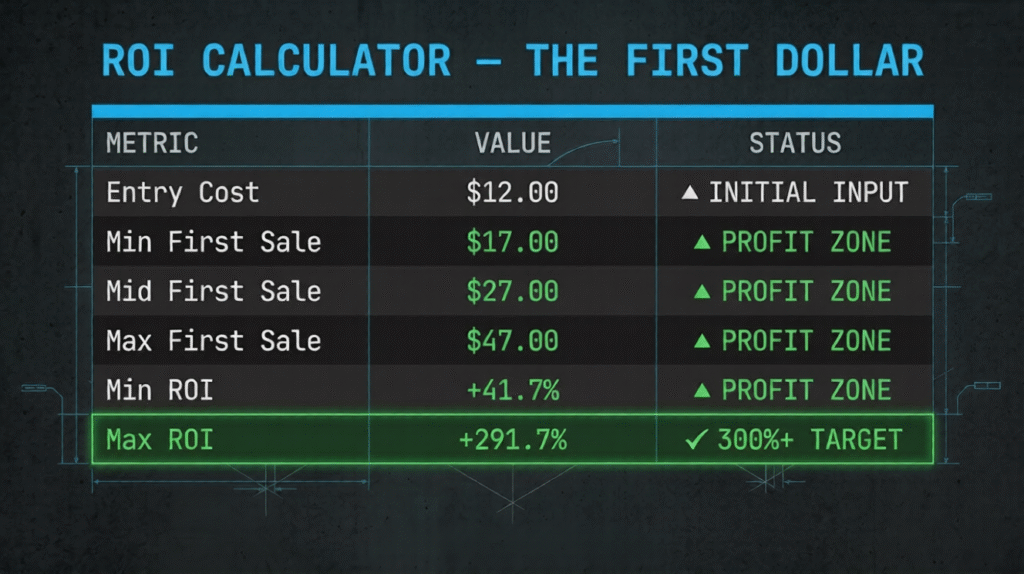
Here’s the economic reality of 2026: the cost of a proof of concept should be less than lunch in Hong Kong or New York. The Quick Vault Starter Kit costs $12. That’s less than a bowl of wonton noodles in Causeway Bay, less than a midtown Manhattan sandwich.
Now run the math. The standard entry-level digital product — what direct-response marketers call a Tripwire — is priced between $17 and $47. A tripwire is a low-friction, high-value product designed to convert cold traffic into paying customers. One sale at $17 generates a 41.7% ROI on your $12 entry cost. One sale at $47 generates a 291.7% return. You didn’t just break even — you crossed the Zero-to-One threshold and generated a net profit before the weekend is over.
This is the asymmetry that beginners miss. The vault isn’t a cost. It’s the raw material for your first transaction. The Tripwire sale doesn’t just pay for the vault — it proves the system works and funds the next iteration.
Actionable Milestone: Calculate your Tripwire price point. Pick a number between $17 and $47. Write it on a piece of paper. That number is the target your 48-hour sprint is aiming at.
Get the ‘First Dollar’ Schematics for $12.
The Starter Kit Modules: What’s Inside the Vault
The Quick Vault is not a course. It’s an operational architecture — five industrial-grade modules engineered for rapid deployment, not passive consumption.
Module 01 — Theory of Administrative Debt: The diagnostic foundation. Understand why manual cognitive labor is bleeding your time (and how to stop it before you build anything).
Module 02 — Architecture of a Perfect Prompt: The 5-Part Master Template — Context, Identity, Constraints, Logic, Output Format — that turns vague AI requests into precision-engineered function calls. This single framework eliminates 80% of “AI doesn’t work for me” complaints instantly.
Module 03 — Core Operations Vault (40 Industrial Prompts): Four categories: Strategic Marketing & Messaging, Sales, Admin & Operations, and Client Fulfillment. Each prompt is pre-engineered with the 5-Part framework. Not templates to copy-paste — instruments to deploy. Highlights include the Brand Voice Extraction Engine (A-01), the Competitive Deconstruction Matrix (A-02), and the Content Pillar Architecture system (A-03), all calibrated for faceless, solo-operator workflows that require zero on-camera presence and minimal setup time.
Module 04 — Implementation Blueprints: Two operational containers — the 15-minute Morning Audit Workflow (daily task processing engine) and the quarterly Bulk Production Method (generates 30 days of content assets in a single 3-hour session). These are the deployment mechanisms that turn Module 03 prompts from ideas into recurring revenue systems.
Module 05 — Compliance & Governance: The Human-in-the-Loop (HITL) protocols and data privacy checklists that keep your AI operations legally defensible and factually accurate.
Actionable Milestone: On Day 1, run only Module 02. Build your Master Template for your chosen offer. Do not touch Module 03 until your template is complete.
The 48-Hour Implementation Plan
This is a clinical sprint, not a creative exercise. Time-box each stage and do not deviate.
Hour 0–2 | System Setup. Create a free Gumroad account. Set your product name, price ($17–$47), and a one-paragraph description using the Value Proposition Stress-Test prompt (A-05) from the vault. Upload a simple PDF or link. Your store is live.
Hour 2–6 | Content Production. Run the Brand Voice Extraction Engine (A-01) using any existing writing — even a LinkedIn post or email. Feed the output into the Content Pillar Architecture (A-03). Use both outputs to generate your first three promotional posts using the 30-Day Content Calendar prompt (A-07). These are your initial traffic drivers.
Hour 6–12 | Distribution. Post to two platforms: a free community (Reddit, Facebook Group, LinkedIn, or niche forum) and one social channel. Do not run paid ads on Day 1. Validate organic traction first. If you have an affiliate product instead of your own, replace the Gumroad setup with a single affiliate landing page — the content production steps are identical.
Hour 12–24 | Monitor and Iterate. Check engagement. If a post gets traction, run the Content Repurposing Engine (A-10) to produce five derivative assets. If zero traction, run the Competitive Deconstruction Matrix (A-02) and reposition the messaging.
Hour 24–48 | The Notification. By Hour 48, you’ve executed a complete proof-of-concept cycle. A sale notification is not guaranteed — but the system required to generate one is now operational. That’s the asset. Run the cycle again.
Actionable Milestone: Set a timer for 48 hours from now. At the end of that timer, you should have a live offer, three published posts, and one completed quality-gate review of your copy. Everything else is noise.

Stop Observing. Participate.
The internet economy does not reward research. It rewards transactions. Every week you spend analyzing, comparing tools, and “getting ready” is a week a competitor with worse ideas but more execution is generating proof-of-concept data that you don’t have.
The vault costs $12. The first Tripwire sale costs nothing after that. The Zero-to-One gap is the only gap that matters — and it’s the only one that, once crossed, cannot be uncrossed.
Stop observing the economy. Participate in it.