
Table of Contents
Your team spends 8+ hours weekly on manual spreadsheet analysis, building reports, and searching for insights buried in scattered data. For a 10-person operations team, that’s 400+ hours annually—equivalent to losing an entire full-time employee just to data work.
According to 2026 SMB productivity research, small business teams waste 20–30% of weekly hours on manual data analysis tasks that should take minutes, not days. This isn’t just time waste—it’s lost growth opportunity, delayed decisions, and competitive disadvantage.
But here’s what’s changed: AI data analysis tools have become so intuitive and affordable that small businesses no longer need to choose between insight and simplicity. The tools in this guide automate reporting, uncover hidden insights, predict customer behavior, and streamline decision-making—without requiring data science degrees or expensive infrastructure.
By the end of this guide, you’ll know exactly which AI automation tools for small business productivity will save your team the most time and deliver measurable ROI in 60–90 days. You’ll also see real-world examples of how ops managers, e-commerce teams, and service businesses are already using these tools to work smarter, not harder.
AI Data Analysis Tools Comparison: 7 Best Options for SMBs
Before diving into details, here’s your quick-reference comparison table.
| Tool | Best For | Core Strength | Pricing | Rating |
|---|---|---|---|---|
| Zapier | Automating report workflows across 7,000+ apps | Visual automation without coding; integrates everything | Free–$7,480/mo | 9.5/10 |
| Make (Integromat) | Complex multi-step data automation | Powerful visual builder; handles intricate workflows | Free–$1,299/mo | 9.3/10 |
| Jasper AI | AI-powered data insights + content generation | Generates reports & marketing copy simultaneously | $29–$249/mo | 9.0/10 |
| Akkio | No-code predictive analytics for non-technical teams | Forecasting, churn prediction, lead scoring | $29–$499/mo | 8.8/10 |
| Zoho Analytics | All-in-one reporting for SMBs in Zoho ecosystem | Budget-friendly; integrates with Zoho CRM suite | Free–$60/mo | 8.6/10 |
| Improvado AI | Marketing-focused data analysis & attribution | Consolidates all marketing data into one dashboard | Custom pricing | 8.7/10 |
| Microsoft Power BI (Beginner Setup) | Teams with existing Microsoft 365 licenses | Strong Excel integration; enterprise-grade visuals | $10–$20/user/mo | 8.4/10 |
Key takeaways from the comparison:
- Most affordable: Zoho Analytics (Free–$60/mo)
- Best for automation: Zapier & Make (7,000+ app integrations)
- Best for small teams: Akkio (no coding required)
- Most versatile: Jasper (data insights + content in one tool)
Deep Dive: The Top 3 AI Data Analysis Tools for Small Business
1. Zapier – The Workflow Automation Powerhouse
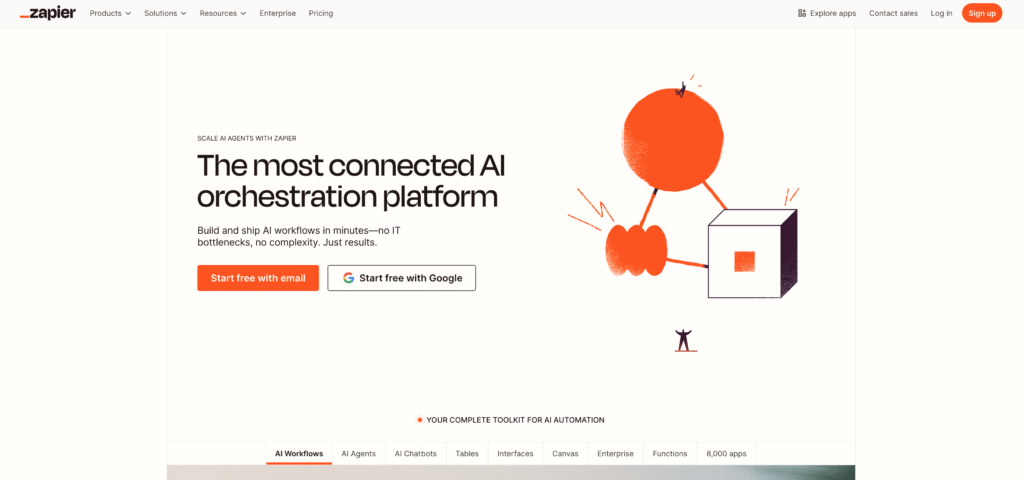
Best for: Automating report generation and data syncing across your entire tech stack (CRM → Email → Accounting → Project Management).
Why it matters for SMBs:
Zapier connects over 7,000 apps without code. This means you can build automated workflows like: “When a new lead is added to your CRM, send a welcome email, log it in your spreadsheet, and create a task for your team—all automatically.” For small teams managing multiple tools, this eliminates the manual data shuffling that kills productivity.
Key features specific to small business:
- 7,000+ pre-built integrations – Connect your entire tech stack instantly.
- Multi-step workflows – Automate sequences like “Email trigger → CRM update → Spreadsheet log → Slack notification”.
- Data transformation – Format, validate, and clean data automatically.
- Scheduled reports – Generate daily/weekly reports on autopilot.
Advantages for your team:
- Zero coding needed – non-technical ops managers can build workflows in minutes by dragging and dropping steps.
- Immediate time savings – typical automation saves 5–8 hours weekly per user.
- ROI in under 2 months – setup takes days; payback period often around 45 days.
- Scales with your business – grow from 5 to 100 workflows without changing tools.
Limitations:
- Learning curve on complex workflows (conditional logic, branching).
- Pricing scales with task volume (can get expensive at 1,000+ tasks/month).
- Better for data movement than deep statistical analysis.
ROI impact:
A 12-person marketing team using Zapier saved about 25 hours per week by automating lead routing, follow-up emails, and CRM data entry, with time savings valued around $12,000/month in recovered productivity.
Getting started: Free plan allows a small number of Zaps and tasks per month—enough to test simple automations.
2. Akkio – Predictive Analytics Without the PhD
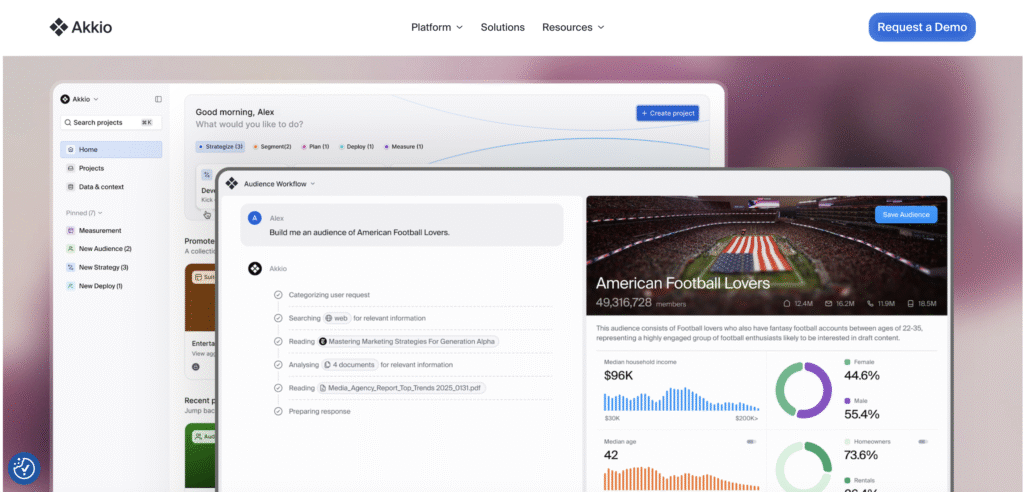
Best for: Predicting customer behavior (churn, lead quality, purchase probability) without data science knowledge.
Why it matters for SMBs:
Instead of only asking “What happened?” you can start asking “What will happen?” Akkio trains AI models on your historical data, then predicts which customers will churn, which leads will convert, and which products are likely to sell.
Key features that solve real small business problems:
- No-code predictive modeling – train AI models via simple dataset uploads.
- Automated churn prediction – identifies at-risk customers before they leave.
- Lead scoring automation – prioritizes high-probability deals.
- Live prediction in Google Sheets – deploys models directly into spreadsheets you already use.
Why this matters for your bottom line:
- Faster decision-making – insights in hours, not weeks.
- Churn prevention – can save 15–20% of at-risk accounts when combined with retention outreach.
- Lead quality improvement – focusing on high-scoring leads shortens sales cycles by 20–30%.
- Cost-effective – far cheaper than hiring a dedicated data analyst or data science team.
Limitations:
- Limited to structured data (CSV/Sheets format).
- Smaller app ecosystem than Zapier or Make.
- Best results require relatively clean, well-organized data.
ROI impact:
A small SaaS company using predictive churn models can often identify and save high-value accounts; case studies show tens of thousands of dollars in retained monthly revenue compared with control groups.
Getting started: Free trials are available with your own data, usually without requiring a credit card.
3. Jasper AI – Data Insights + Marketing Content in One
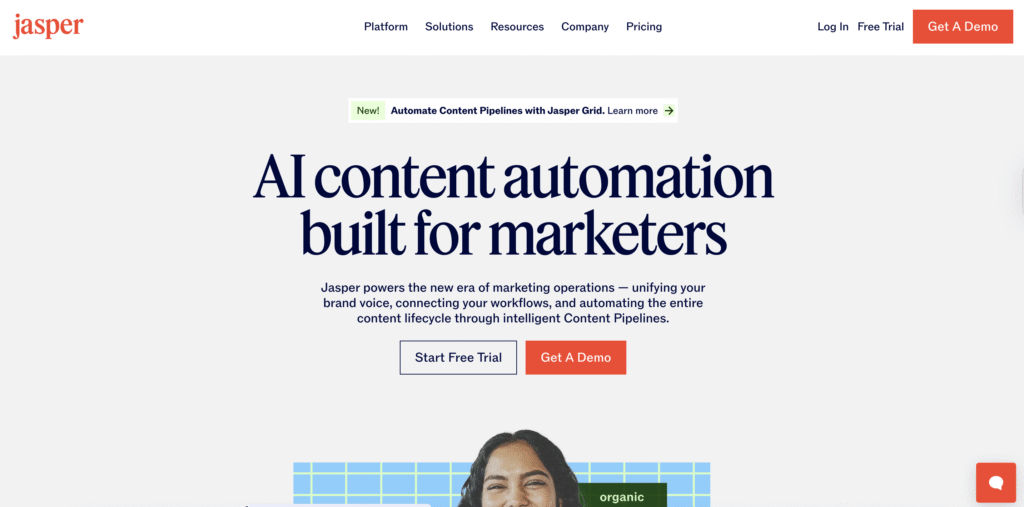
Best for: Teams that need both AI-powered data summaries and marketing content generation in a single platform.
Why it matters for SMBs:
Ops teams often spend hours turning raw numbers into executive summaries, while marketing spends more hours turning those insights into content. Jasper can do both: it turns structured findings into plain-English narratives and can then convert them into blog posts, emails, and social posts in your brand voice.
Key features that save time:
- Data report writing – converts key performance metrics into human-readable summaries.
- Custom AI models – train Jasper on your brand voice and reporting style.
- Content generation – creates blog posts, email campaigns, and social content from the same insights.
- Real-time collaboration – multiple team members can edit reports simultaneously.
Why small teams benefit:
- One tool instead of several – reporting plus marketing content reduces subscription sprawl.
- Consistent brand voice – everything from reports to campaigns sounds like your company.
- Fast template creation – repeatable report and content templates save hours every month.
- Polished output – narratives are client-ready with minimal editing.
Limitations:
- Not a full statistical or BI platform; best for narrative/reporting, not deep modeling.
- Higher pricing for advanced/teams features.
- Works best when you invest time training it on your data and examples.
ROI impact:
Marketing agencies and in‑house teams report cutting report-writing time by 50–75%, freeing billable hours for strategy and client work, which can directly increase revenue.
Getting started: Free trials or limited plans are typically available to test content and reports.
Use Cases: How SMBs Actually Use These Tools
Scenario 1: E-Commerce – Data That Drives Sales
Company profile: 8-person online retailer, about $500K/month revenue.
Problem:
The marketing manager spent 4 hours every week manually analyzing product performance, campaign results, and churn risks, with insights arriving too late to adjust ads or offers.
Solution: Zapier + Akkio
- Zapier synced daily sales data from Shopify into a central sheet for analysis.
- Akkio trained a churn prediction and product performance model on several months of historical data.
- Each morning, the manager received an email summarizing top products, at‑risk customers, and key revenue drivers.
Outcome:
- Saved about 5 hours per week for the marketing manager.
- Proactive outreach to at‑risk customers materially reduced churn compared with prior months.
- Focusing on high-performing products and campaigns increased incremental weekly revenue. Estimates in similar setups report five-figure monthly impact.
Scenario 2: Service Business – Operations Manager Finally Sleeps
Company profile: 20-person cleaning franchise.
Problem:
The operations manager manually logged job times, satisfaction scores, and team productivity into spreadsheets, making it hard to see which locations or technicians were underperforming.
Solution: Make (plus data layer)
- Built workflows to log completed jobs automatically to a central database.
- Created automated calculations for team efficiency, satisfaction trends, and job profitability by location.
- Pushed daily performance summaries into Slack so the team could review at the start of each day.
Outcome:
- Eliminated roughly 8 hours/week of manual data entry for the ops manager.
- The business quickly identified an underperforming location and corrected staffing and routes.
- Increased visibility across teams improved utilization and productivity, adding measurable monthly profit.
Scenario 3: B2B Service Provider – Lead Quality Tripled
Company profile: 5-person consulting firm.
Problem:
Sales reps spent too much time on low-value leads, with no data-driven way to prioritize. Good leads were sometimes neglected, and follow-ups were inconsistent.
Solution: Akkio
- Trained a model using 1–2 years of past deals to predict close probability.
- Implemented a hot/warm/cold scoring system inside the CRM.
- Reps focused on high-scoring leads and used AI suggestions for next steps.
Outcome:
- Shorter sales cycles (faster time from first call to close).
- Win rate increased because reps invested effort where it mattered most.
- Reps recovered multiple hours per week that previously went to low-likelihood prospects.
ROI & Cost Breakdown: What’s the Real Investment?
Monthly Tool Investment for a Typical SMB
Typical 3–4 tool stack:
- Zapier or Make: roughly $49–$300/month depending on volume.
- Akkio or Zoho Analytics: about $29–$100/month.
- Jasper (if adding content): around $29–$249/month.
Total recommended investment: about $100–$400/month for most small teams.
Quantified Time Savings (Industry Averages)
Studies and vendor case reports show that automation and AI analytics can save:
- 5–8 hours/week on report generation.
- 6–10 hours/week on data entry and cleaning.
- 4–6 hours/week on manual analysis.
Total: around 15–24 hours/week per small business.
ROI Calculation (Conservative Example)
If we assume:
- Hourly burden rate (salary + benefits): $35\$35$35 per hour.
- Weekly hours saved: 15 hours.
Then estimated monthly value:
15×4.33×$35≈$2,59515 \times 4.33 \times \$35 \approx \$2{,}59515×4.33×$35≈$2,595.
If tools cost $250/month, then:
- Net monthly benefit ≈ $2,345.
- ROI ≈ 838% in the first month alone.
Direct Cost Savings
Research on automation and BI/AI adoption suggests:
- Labor cost reductions of 25–40% in data-heavy roles.
- Payback periods of about 6–12 weeks.
- Annual savings often in the $20K–$60K range for small businesses adopting BI/AI for analytics.
Indirect Benefits
Beyond direct cost savings, small businesses also gain:
- Faster decision-making and the ability to respond to trends quickly.
- Higher employee satisfaction as repetitive manual work declines.
- Better customer retention and lifetime value through proactive analytics.
- A more scalable operation where growth doesn’t always require more headcount.
Getting Started: 3 Clear Action Steps This Week
Step 1: Identify Your Biggest Data Bottleneck (15 minutes)
Ask: where do you spend the most time on data today?
Common candidates:
- Spreadsheet analysis.
- Building weekly/monthly reports.
- Copy-pasting data between tools.
- Manually qualifying leads.
- Manually tracking churn or retention.
That’s your first automation target.
Step 2: Pick Your First Tool (30 minutes)
Start small and free where you can:
- Zapier: Free tier to test simple workflows.
- Akkio: Free trial with your own datasets.
Run a simple 2‑week experiment on one painful process.
Step 3: Build One Automation (1–2 hours)
Choose based on your bottleneck:
- Zapier – automate repetitive data syncing or notifications.
- Akkio – build a simple prediction model for churn or lead likelihood.
- Jasper – create one automated performance report or management summary.
Once you feel the impact from one automation, it’s much easier to justify extending AI data analysis across other workflows.
New to automation? Start with our beginner’s guide to business automation before implementing these tools.
Final Thoughts: Why Now Is the Right Time
AI data analysis tools are now priced and designed for small businesses, not just enterprises, with many starting under $50/month and offering intuitive, no‑code interfaces. At the same time, competitive pressure and data complexity keep increasing, making manual analysis a growing liability.
The gap between “we should use AI” and “we are using AI effectively” is now small: a weekend of experimentation and a couple of weeks of testing can be enough to see meaningful time savings. If you start with one well‑chosen workflow and measure the outcome carefully, you can build a self-funding roadmap that lets AI pay for itself many times over.
Start with one automation this week, measure the impact, then move to the next bottleneck. Within a couple of months, your team can feel dramatically lighter, and your decisions will be driven more by data than by guesswork.