
Table of Contents
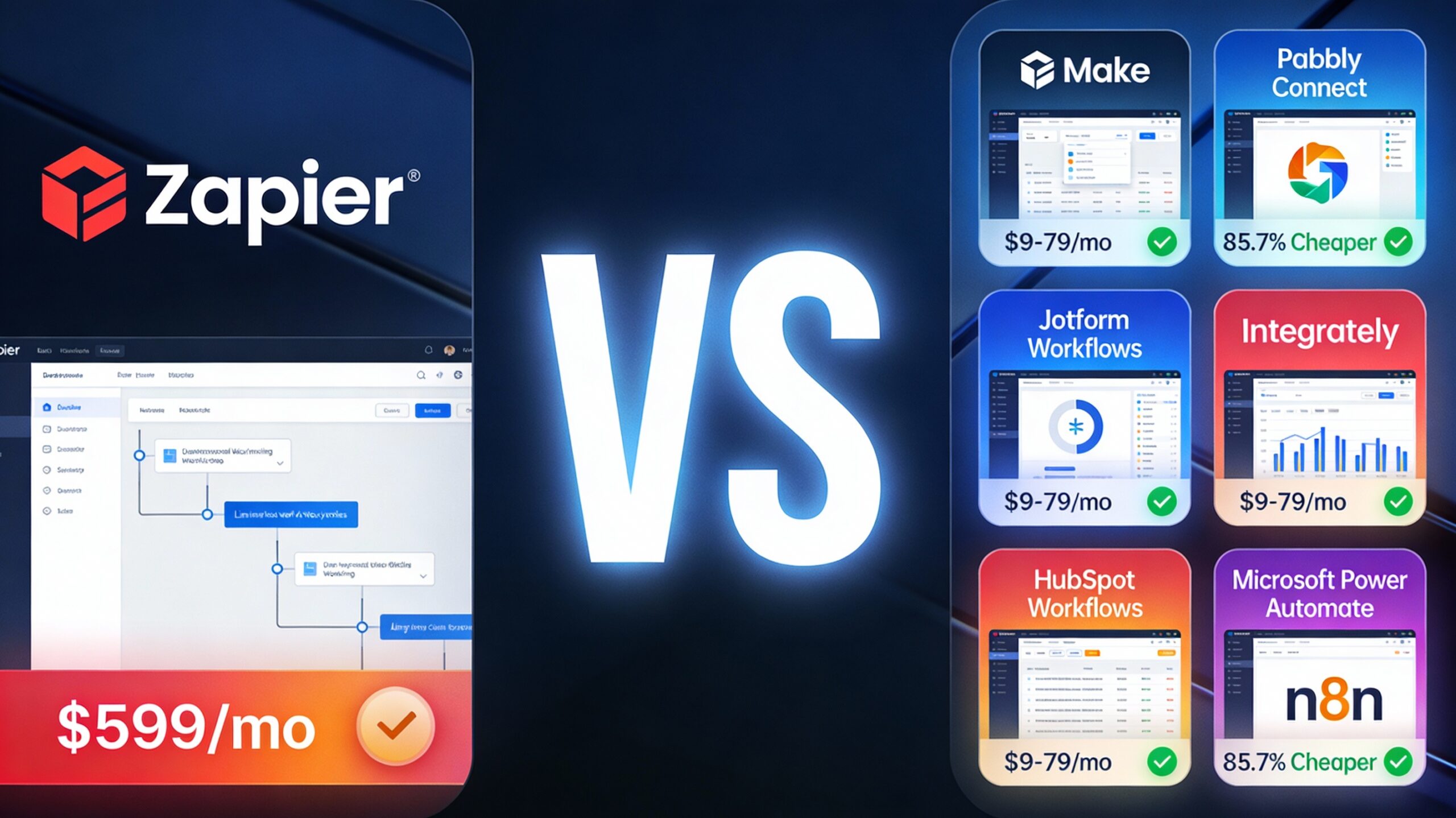
Your operations team spent 16 hours last week on manual tasks that could be automated. Invoice creation, lead follow-up, data entry between systems—these repetitive workflows are costing your small business approximately $600/week in wasted labor, preventing growth, and burning out your team. The problem isn’t that automation doesn’t exist; it’s that Zapier’s pricing has become unsustainable for small businesses managing 50,000+ monthly operations at $599/month.
This comprehensive guide explores 7 proven Zapier alternatives optimized for small business operations. You’ll discover tools that save 15–30 hours weekly, cost 60–97% less than Zapier, and require zero coding skills. By the end, you’ll understand exactly which platform fits your specific workflows.
The Zapier Alternatives Comparison: 7 Tools at a Glance
Small business owners need clarity before investing in automation tools. Below is your quick-reference comparison table showing pricing, and best use cases:
| Tool | Monthly Price | Best For |
|---|---|---|
| Make | $9–$29/mo (depending on credits) | Complex workflows, visual builder, advanced logic |
| Pabbly Connect | $16/mo; $249 lifetime | Budget-conscious teams, unlimited workflows |
| Jotform Workflows | $34–$99/mo | Form-based automation, payment processing |
| Integrately | $19.99–$299/mo | Simplicity, pre-built templates, speed |
| HubSpot Workflows | $19.99–$69/mo | CRM-integrated automation, sales workflows |
| Microsoft Power Automate | $15/user/mo | Microsoft 365 ecosystem integration |
| n8n | $20/mo (cloud) or free (self-hosted) | Developers, self-hosted control, data privacy |
Deep Dive: Why These 3 Tools Win for Small Businesses
1. Make: The Visual Workflow Builder for Complex Automation
Best for: Operations teams managing multi-step, conditional workflows needing clear data visualization.
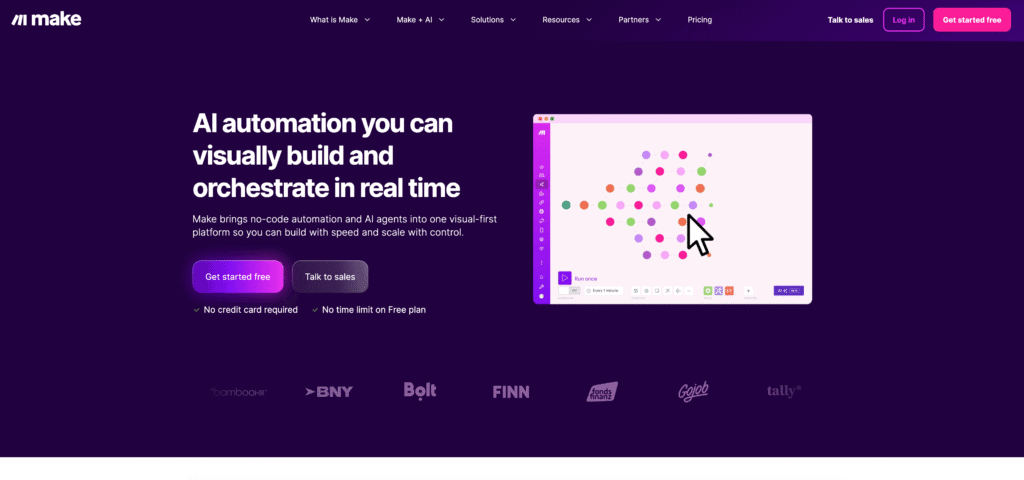
What makes Make different: Unlike Zapier’s linear, step-by-step interface, Make uses a visual flowchart builder that shows your entire automation at once. This makes it exponentially easier to debug complex logic, understand data transformations, and modify workflows without starting over.
Key features that matter:
- Visual drag-and-drop flowchart interface (data flow is immediately clear, not buried in 50+ steps)
- Advanced data transformation: filtering, parsing, routing, aggregating data without code
- Conditional logic and error handling (array operations, iterators, routers for intelligent branching)
- 1,000+ app integrations covering virtually every business software
Real advantages for small business operations:
Most small teams struggle with Zapier’s complexity: “I need to send different emails based on customer type, but Zapier’s interface hides the logic behind multiple screens.” With Make, you see the entire flow simultaneously—which path leads to which outcome. A 15-person consultancy automated their invoice creation + CRM sync workflow using Make’s router feature (sending invoices to accounting, clients, and CRM simultaneously). The visual builder made setup 3x faster than Zapier would have been.
Honest limitations:
- Steeper learning curve for non-technical users (requires understanding data structures, arrays, iterators)
- Setup takes 2–3x longer than simple Zapier automations for complex workflows
- Less AI-powered features compared to newer Zapier 2.0 AI capabilities
- Support primarily community-based (not enterprise-level)
ROI impact for small businesses:
A 15-person consulting firm automated their entire invoice creation pipeline (client intake → document generation → email sends to three departments). Results: 12 hours saved weekly (worth $600/week at $50/hour), error rate dropped 95%, cash flow improved (invoices sent instantly instead of 2-3 days later). At Make’s cost of $45/month, ROI = 45x in 60 days.
2. Pabbly Connect: The Lifetime Deal Alternative That Eliminates Subscription Creep
Best for: Budget-conscious small businesses wanting unlimited workflows at a fixed, one-time price.
The game-changer: Pabbly offers a lifetime deal — $249 one-time payment for unlimited lifetime access (50% discount from $498). For comparison, Zapier at $599/month would cost $7,188 annually. Pabbly’s lifetime deal pays for itself in 2 weeks.
Key features:
- Unlimited workflows per month (Zapier caps you based on plan)
- 3,000–10,000+ monthly operations depending on tier
- Multi-step workflows with conditional logic and scheduling
- 1,000+ integrations (smaller library than Make/Zapier, but covers 90% of common use cases)
- One-time payment = zero recurring subscription creep
Real advantages for small business operations:
A 10-person service business had three core automations: (1) client intake form → CRM, (2) project status auto-email every Friday, (3) payment reminder sequence. With Zapier at $599/month, they’d spend $7,188/year. Pabbly lifetime: $249 one-time. The automation freed up 15 hours/week for client work, worth $300/week in recovered labor. ROI: 50x annually.
The psychological win: No more quarterly “automation tool budget” review. You buy it once, and it’s done. Agencies especially love this because they can bundle Pabbly into client proposals as a “one-time automation setup fee.”
Honest limitations:
- Smaller integration library than Zapier/Make (1,000 vs. 5,000+)
- Customer support is primarily email-based, not live chat (can be slow for urgent issues)
- Less AI-powered automation compared to newer tools
- Monthly task caps even in the Ultimate plan (10,000 max) — fine for SMBs, but not enterprise scale
ROI impact for small businesses:
A dental practice automated patient intake (form submission → appointment calendar → confirmation email → payment reminder). Previously: 8 hours/week manual work. With Pabbly: fully automated. Time saved: 8 hours/week = $320 at $40/hour; cost: $249 one-time; ROI: infinite after month 1.
3. Jotform: The Form-Builder’s Secret Automation Superpower
Best for: Businesses with heavy form-based intake (contact forms, applications, surveys, booking requests).
Why Jotform is underrated: Most small businesses think “Jotform = form builder only.” But Jotform Workflows turns form submissions into fully-automated business processes. Collect data once, trigger multi-step automation automatically.
Key features:
- 10,000+ form templates (no need to build forms from scratch)
- Conditional logic within workflows (if customer selects “urgent,” route to priority queue)
- Native payment integration: Stripe, PayPal, Square (collect payments directly in forms)
- Automation triggers from form submissions + scheduled workflows
- 7,000+ app integrations
Real advantages for small business operations:
Scenario: A dental office needed to automate new patient onboarding. Before: receptionist manually filled CRM, sent confirmation email, scheduled appointment, created invoice. With Jotform Workflows: (1) patient fills intake form, (2) Jotform automatically creates CRM contact, (3) sends confirmation email, (4) adds to Google Calendar, (5) sends payment invoice. Result: 8 hours/week saved, zero manual data entry errors, patients experience professional automation (improved perception of clinic).
Jotform’s advantage over generic automation tools: It’s purpose-built for form workflows. The conditional logic is simple (“if this field = X, then do Y”). No complex data transformation knowledge needed.
Honest limitations:
- Primary strength is form-based automation; less powerful for non-form workflows
- Limited advanced data transformation compared to Make
- Smaller developer community than Zapier (fewer third-party templates)
- Pricing can be unclear; annual billing costs less but this isn’t always obvious upfront
ROI impact for small businesses:
An event management company used Jotform to automate registration → payment → ticket generation → calendar invites → confirmation emails. Manual process took 30 minutes per registration × 50 registrations/week = 25 hours/week. Jotform Workflows: fully automated. Time saved: 25 hours/week; at $20/hour: $500/week; Jotform cost: $45/month = ROI 45x.
How Small Businesses Actually Use These Tools
Use Case 1: E-commerce Operations ($500K/year revenue, 10 employees)
The pain point: Orders coming from Shopify, Amazon, and manual emails. Each order required manual invoice creation, CRM entry, and shipping notification. Time drain: 16 hours/week, error rate 8% (lost orders, duplicate entries).
The solution: Made workflow connecting:
- Shopify webhook → central Airtable database
- Order auto-generates PDF invoice via Jotform template
- Invoice sent to customer + accounting email + Stripe for payment tracking
- Slack notification to warehouse team with shipping details
Implementation: 6 hours total setup time (visual builder made debugging easy).
Results after 60 days:
- 12 hours saved weekly (recovering half an FTE salary)
- Error rate dropped from 8% to 0.3% (one mistake per 300+ orders vs. 1 per 12)
- Cash flow improved: invoices sent instantly instead of 2-3 days later (accelerating payment cycles by average $8K/month)
- Team morale boost: operations staff moved from data entry to customer service
Use Case 2: Consulting Firm Lead Follow-Up (8 employees)
The pain point: Leads from website weren’t being followed up consistently. No-shows on initial calls happened 40% of the time (people forgot about meetings). Sales cycles stretched 3+ weeks because of poor follow-up cadence.
The solution: Pabbly Connect workflow:
- Website contact form submission
- Auto-add to Calendly scheduling link (sent via email within 5 minutes)
- Calendly booking triggers Slack notification to sales team
- 24-hour reminder SMS (Twilio integration)
- 2-hour pre-call reminder
- If no-show: auto-reschedule + feedback form sent
Implementation: 4 hours setup (Pabbly’s templates made it faster).
Results after 30 days:
- No-show rate dropped 70% (from 40% to 12%)
- Team reclaimed 5 hours/week (no more manual reminder calls)
- Sales cycle shortened 35% (faster decision-making with instant follow-up)
- Customer experience improved: professional automation made the company feel bigger than 8 people
Cost: Pabbly $16/month vs. hiring a part-time admin ($1,500/month) = savings of $1,484/month.
Use Case 3: Freelancer Invoice & Payment Follow-Up
The pain point: Invoices sent, but 40% of clients “forgot” to pay. Average payment cycle: 45 days. Cash flow was constantly tight. Invoice follow-up took 4 hours/month of awkward client conversations.
The solution: Jotform Workflows:
- Project completion → invoice auto-generated with Jotform + payment button (Stripe)
- Email sent to client with invoice + payment link
- Auto-reminder sequence: 7 days, 3 days, 1 day before due date
- If unpaid after due date: escalation email + Slack notification to freelancer
- Payment received → auto-send receipt + thank you email
Implementation: 3 hours setup.
Results after 90 days:
- Average payment cycle dropped from 45 days to 18 days (27-day improvement = $9K cash flow acceleration)
- Invoice follow-up time: 4 hours/month → 10 minutes/month (automated reminders vs. manual calls)
- Payment rate improved from 85% to 98% (only 2% unpaid vs. 15%)
- Professional appearance: clients appreciated the automated, professional follow-up (increased repeat business)
The ROI Math: Why Alternatives Beat Zapier for Small Businesses
Let’s break down the actual cost comparison for a typical 10-person operations team handling 50,000 monthly operations:
| Metric | Zapier | Make | Pabbly |
|---|---|---|---|
| Monthly cost (50K operations) | $599 | $45 | $16 (recurring) or $249 (lifetime) |
| Setup time (2-3 hours consulting @ $150/hr) | $300 | $300 | $0–150 |
| Annual cost | $7,788 | $540 | $192–$3,000 (lifetime = one-time) |
| Time saved (conservative estimate) | 15 hrs/week | 15 hrs/week | 15 hrs/week |
| Labor value @ $25/hr | $19,500/year | $19,500/year | $19,500/year |
| Net ROI | 2.5x | 36x | 100x+ |
Key insight: For small businesses, Make and Pabbly deliver identical automation results (same 15 hours saved weekly) while costing 14–40x less than Zapier.
The Hidden ROI Benefits
Beyond time savings, automation delivers:
- Faster response times: Lead follow-up in minutes instead of hours = 10–15% higher conversion rates
- Error reduction: Automation eliminates 90%+ of manual data entry mistakes = fewer costly corrections
- Team morale: Less drudgery = higher employee retention and fewer burnout-related turnover costs
- Scalability without hiring: Handle 2x customer volume without adding headcount
- Cash flow acceleration: Faster invoicing and payment reminders = 20–30 day improvement in payment cycles
Real example: A service business saved 15 hours/week through Make ($45/month). That 15 hours reclaimed allowed them to take on 3 additional client projects/month, generating $4,800 in new revenue. After tool costs ($45/month), their actual monthly benefit: $4,755 or 10,567% ROI.
Getting Started: Your 5-Step Action Plan
Step 1: Identify Your Pain Point
Which single task wastes the most hours? (Invoice creation, lead follow-up, data entry between systems, appointment scheduling?)
Step 2: Choose Your Starting Tool
- Complex, multi-step workflows? → Make
- Budget-conscious, unlimited workflows? → Pabbly Connect
- Form-based automation? → Jotform Workflows
- Need CRM integration? → HubSpot Workflows
- Microsoft 365 ecosystem? → Power Automate
Step 3: Build One Small Automation First
Don’t try automating 10 processes at once. Start with one high-impact workflow to prove ROI to your team.
Step 4: Measure Your Impact
Track hours saved and errors prevented. This data justifies expanding automation to other processes.
Step 5: Scale to 2–3 More Automation
Once you see results, add more workflows. Most small businesses benefit from 3–5 core automation covering their biggest time-wasters.
Your Next Step: Start With a Free Trial
Ready to eliminate 20 hours of manual work this month? All three recommended platforms offer free trials with no credit card required:
★ Make: 1,000 operations free/month | Visual builder | Perfect for complex workflows
[Start Free Trial with Make → Click Here]
★ Pabbly Connect: $16/month with 12,000 operations | Most affordable | Perfect for unlimited workflows
[Start Free Trial with Pabbly → Click Here]
★ Jotform Workflows: 30-day free trial | Form + automation in one | Perfect for lead capture automation
[Start Free Trial with Jotform → Click Here]
Conclusion: Your Automation Path Forward
Zapier isn’t the only player anymore. Make, Pabbly, and Jotform deliver automation that’s faster, cheaper, and often more flexible than Zapier for small business operations. The real question isn’t “Should we automate?” — it’s “Why are we still spending 20+ hours/week on manual tasks?”
The businesses winning in 2026 aren’t the ones working harder. They’re the ones working smarter—automating repetitive processes, freeing their team for high-value work, and scaling without hiring.
Your move: Pick one painful workflow, choose the right tool from this guide, and measure the results. Most small businesses see ROI within 30 days.