
Table of Contents
You’re managing your Shopify store, and you’re juggling a hundred things. Inventory checks every morning. Cart abandonment emails manually sent. Customer support tickets piling up. And somehow, your competitors seem to be operating with half the staff.
The gap isn’t luck or resources—it’s AI automation.
In 2025, 51% of ecommerce businesses are already using AI to streamline operations, increase conversions, and scale without hiring more people. The question isn’t whether to adopt AI anymore. It’s which tools work best for your specific bottleneck.
This guide breaks down the six most effective tools of AI automation for ecommerce, shows you exactly how much revenue and time they save, and provides a realistic roadmap to implement them in your Shopify store.
Why AI Automation Matters for Small Ecommerce Businesses Right Now
Before diving into specific tools, let’s establish the financial case. If you’re running a small ecommerce business, automation isn’t a luxury—it’s a competitive necessity.
The numbers are compelling: small businesses investing in AI automation see an average return of $5.44 for every dollar spent, with 85% reporting measurable returns within their first year. Shoppers using AI chatbots convert at 12.3%, compared to just 3.1% without—nearly a fourfold increase. And for inventory management alone, AI-driven forecasting reduces holding costs by 15-25% while improving accuracy by 30-50%.
The core insight: AI doesn’t replace you—it handles the repetitive work so you can focus on strategy, growth, and building real relationships with customers.
Before AI automation: You spend 2 hours every morning checking stock levels. Support tickets go unanswered for hours. Marketing campaigns run on static segments. Ad budgets stay fixed regardless of performance.
After AI automation: Restock alerts reach your inbox with auto-generated purchase orders. Chatbots handle 70% of support inquiries, with humans stepping in for complex issues. Campaigns adjust dynamically based on customer behavior. Ad budgets reallocate to top performers in real-time.
The difference is time—and ultimately, revenue.
The 6 Best Tools of AI Automation for Ecommerce in 2026
| Tool Name | Best For | Starting Price | Free Plan | Key Features for Ecommerce |
|---|---|---|---|---|
| Tidio | Customer support & sales assistance | $29/month | Yes | 24/7 support, unlimited replies, easy handoff to humans, NLP-powered |
| Pricing AI | Dynamic pricing optimization | $9.99/month | Yes | Unlimited pricing rules, scheduled rules, real-time price changes, rule-based automation |
| Nosto | Product recommendations & personalization | Custom | No | Real-time recommendations, email personalization, behavior analysis, multi-channel |
| Jasper | Content creation & product descriptions | $69/month | No | 30+ languages, brand voice training, A/B copy testing, SEO optimization |
| Shopify Flow | Workflow automation & order management | Free | Yes | Native Shopify integration, conditional logic, inventory triggers, customer tagging |
| Prediko | Inventory forecasting & demand planning | $49/month | No | SKU-level forecasting, real-time alerts, multi-warehouse support, 1000+ Shopify brands |
1. Tidio – Best for 24/7 Customer Support & Sales
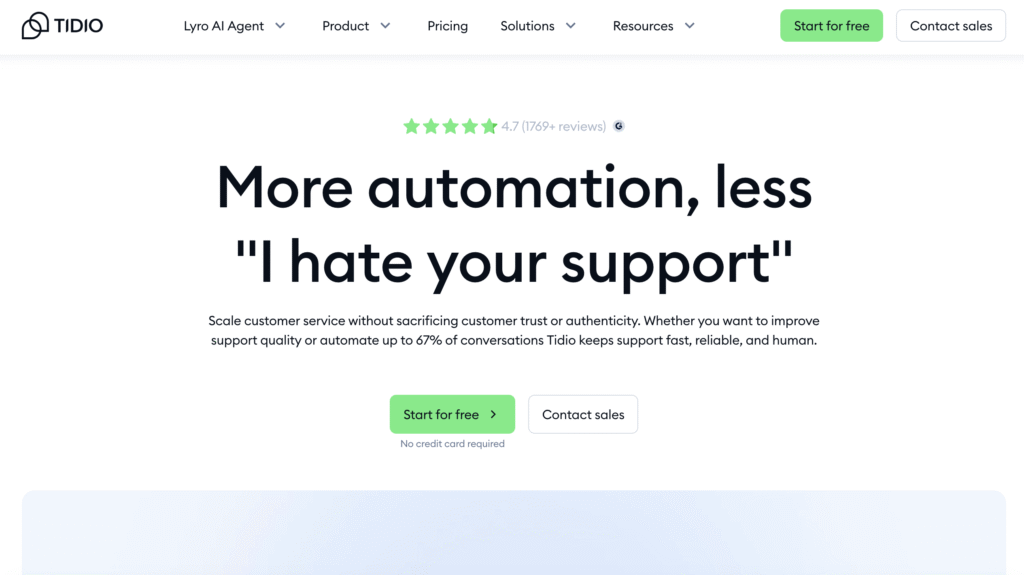
Why it matters for ecommerce: Customer support is your first impression and a critical conversion lever. A single slow response can lose a sale. Tidio handles this at scale, 24/7.
Tidio is an AI chatbot built specifically for ecommerce. It uses natural language processing to understand customer intent—whether it’s “Do you have size XL in blue?” or “How do I return this?”—and responds in real-time, in seconds. Unlike generic chatbots, learns your product catalog, policies, and tone, so responses feel brand-authentic, not robotic.
Key Features for Ecommerce:
- 24/7 availability across website and messaging channels
- Unlimited customer conversations (no per-message caps)
- Seamless handoff to human agents for complex issues
- Integration with Shopify inventory for real-time product checks
- Learning from past interactions to improve responses over time
- Support for common queries: order status, returns, product recommendations
Pricing: Starting at $29/month for 50 conversations. Scales predictably as your business grows.
Free Plan: Yes—50 Tidio conversations per month to test before committing.
Real Impact: E-commerce sites using AI chatbots report 23% average conversion rate increases and 18% faster issue resolution times. One study found that shoppers using AI chat convert at 12.3%, versus 3.1% without—a 4x improvement. Returning customers spend 25% more when they’ve interacted with AI support.
Best for: Solopreneurs and small teams (1-5 people) handling 50-500+ monthly customer inquiries. Ideal if your current support burden is visible: unanswered emails, delayed Shopify chat responses, or customer complaints about slow replies.
>> Try Tidio For Free <<
2. Pricing.AI – Best for Dynamic Pricing & Revenue Optimization
Why it matters for ecommerce: Your price is one of the two biggest conversion levers (along with product-market fit). But most small stores use static pricing—the same price for everyone, all the time. Dynamic pricing adjusts in real-time based on demand, inventory, and competition, capturing more margin on high-demand items and accelerating clearance on overstocks.
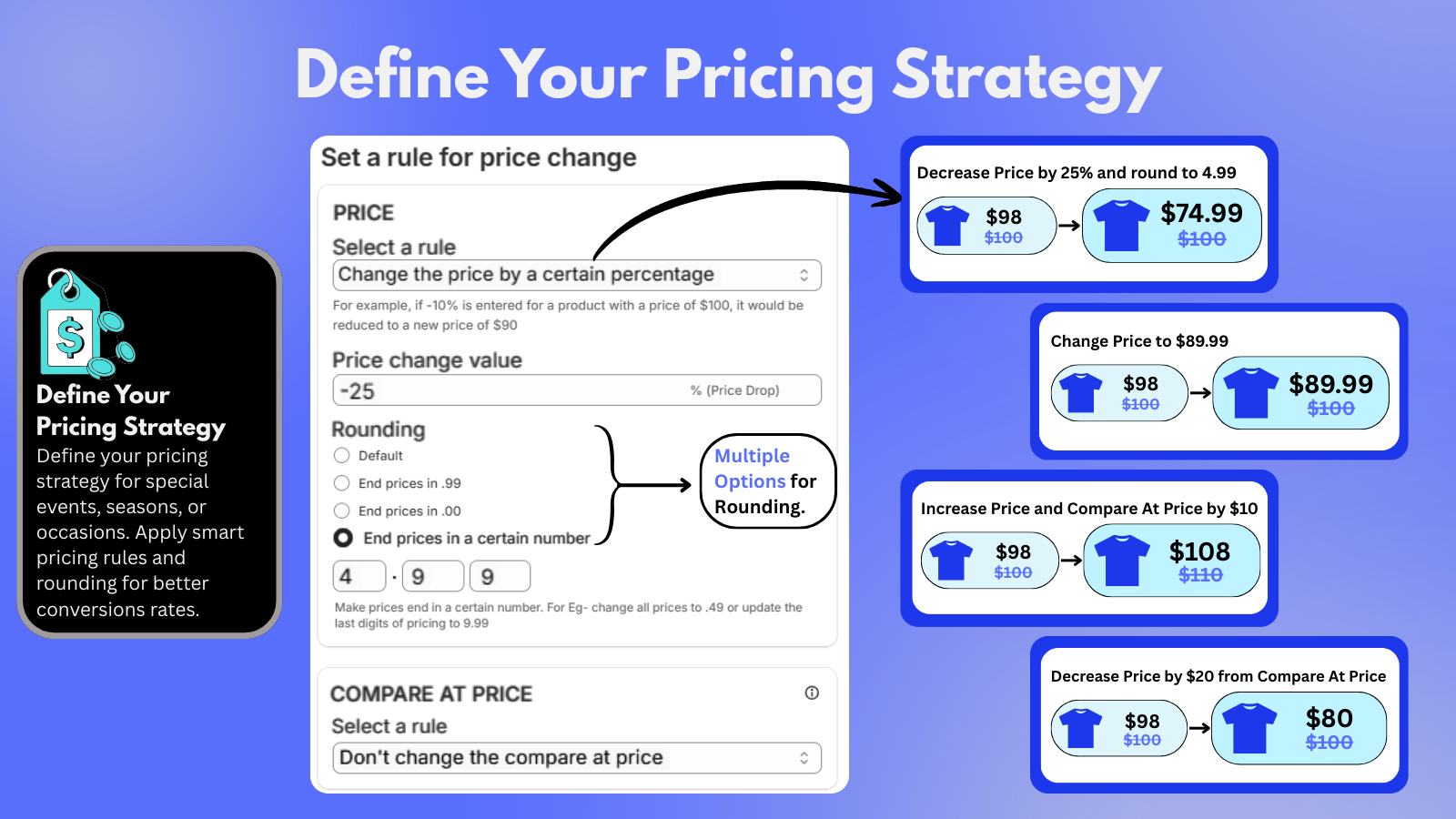
Pricing.AI lets you set rules (not code) that automatically adjust product prices. For example: “If inventory is below 10 units, increase price by 15%.” Or: “If competitor X drops their price on this product, match it within 2 hours.” These rules run continuously, without your involvement.
Key Features for Ecommerce:
- Unlimited pricing rules (no SKU limits on free plan for up to 250 changes/month)
- Scheduled price changes (e.g., weekly discounts, seasonal promotions)
- Competitor-based repricing (track rivals, adjust automatically)
- Inventory-based rules (raise prices on low stock, lower on overstock)
- Time-based promos (flash sales, time-limited discounts)
- Bulk price edits with easy rollback if something goes wrong
Pricing: Free (up to 250 price changes/month) → Lite ($9.99/mo) → Essential ($19.99/mo) → Unlimited ($49.99/mo). 7-day free trial on paid plans.
Free Plan: Genuinely useful for testing. 250 changes/month handles most small stores.
Real Impact: Dynamic pricing drives 15-25% revenue increases on average while maintaining competitive positioning. One retailer saw margin improvement of 10-20% simply by automating price adjustments based on inventory levels. E-commerce brands using AI pricing report faster response to market changes—moving from days to minutes.
Best for: Stores with 50+ SKUs, seasonal trends, or competitors changing prices frequently. If you’re manually adjusting prices, losing margin on clearance items, or unsure whether your pricing is competitive, this tool pays for itself quickly.
Important caveat: Monitor carefully to avoid race-to-the-bottom pricing wars. Use “minimum price” rules and margin guardrails.
>> Get Pricing.AI For Free Here <<
3. Nosto – Best for Personalized Product Recommendations
Why it matters for ecommerce: Amazon generates 35% of its revenue from product recommendations. You don’t need Amazon’s scale to benefit—even modest recommendation engines drive 15-30% conversion increases and 20-40% average order value growth.
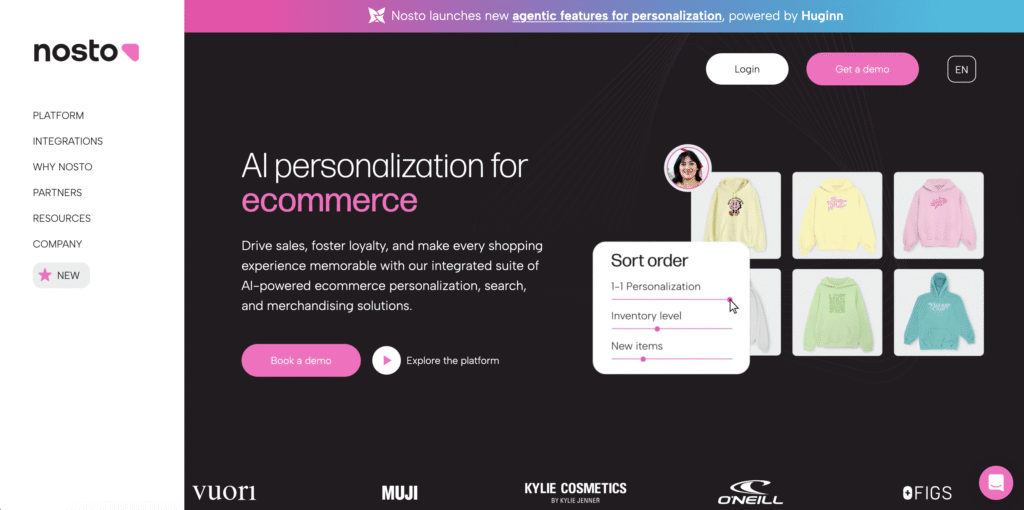
Nosto analyzes each visitor in real-time: their browsing path, past purchases, time on site, device type, even traffic source. It then serves personalized product suggestions on your homepage, product pages, and in abandoned-cart emails. The result: customers find items they actually want, and your revenue-per-visitor climbs.
Key Features for Ecommerce:
- Real-time behavioral tracking (no waiting for batch processes)
- Multi-channel recommendations (on-site, email, SMS, ads)
- A/B testing to optimize which recommendations convert best
- Personalized homepage (changes based on visitor segment)
- Smart cross-sell and upsell suggestions
- Direct integration with Shopify—no coding required
Pricing: Custom (enterprise-level tool). Typically $200-500+/month depending on traffic volume and product catalog size.
Free Plan: No formal free trial, but demos available.
Real Impact: Personalized recommendations increase conversion rates by 15-30% and customer lifetime value by 20-35%. One jewelry retailer (Sapphire) achieved 12x ROI from implementing Smart Recommender technology. Customers who see relevant suggestions reduce bounce rate and complete transactions faster.
Best for: Stores with 100+ products and 1,000+ monthly visitors. If you’re seeing high bounce rates or low average order values despite good traffic, personalization is your lever. Also ideal if you’ve launched new product lines—recommendations help customers discover them.
>> Try Nosto Today <<
4. Jasper – Best for Automated Content Creation
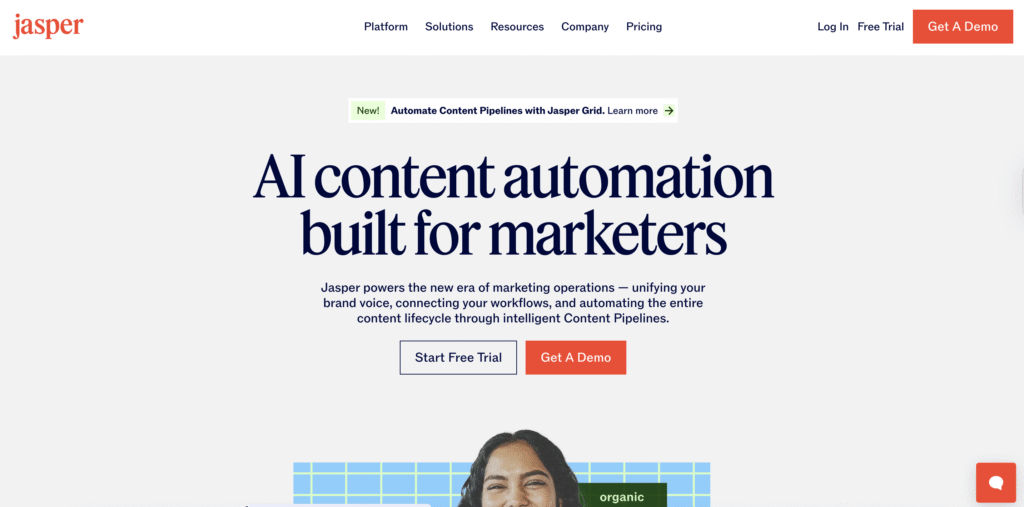
Why it matters for ecommerce: Writing product descriptions, blog posts, email copy, and ad headlines is time-consuming. Jasper generates high-quality, brand-aligned content in minutes, not hours. You focus on strategy; AI handles the drafting.
Jasper is a generative AI writing tool trained specifically for marketing and ecommerce. You give it your brand voice, product details, and target audience—it outputs polished copy ready to publish or refine. It also analyzes your best-performing content and suggests improvements.
Key Features for Ecommerce:
- 30+ language support (global expansion ready)
- Brand voice training (learns your tone, terminology, values)
- Templates for product descriptions, email sequences, social media posts, ad copy
- AI-powered A/B copy testing (generates multiple versions, ranks them)
- SEO optimization suggestions for descriptions and blog posts
- Bulk content generation (describe 50 products, generate descriptions for all)
Pricing: Pro ($69/month per user) → Business (custom). Annual discounts available (20% savings).
Free Plan: 5,000 words/month (limited, but enough to test).
Real Impact: Ecommerce brands report 3x faster content production using AI writing tools. One brand using Jasper reduced time spent on product descriptions from 8 hours/week to 2 hours/week of refinement. OptiMonk (an AI personalization tool) reports that brands see average 24.3% lift in online revenue after implementing AI-generated product content.
Best for: Stores with large catalogs (100+ products) or those running multiple marketing channels (blog, email, social, ads). Solopreneurs find it especially valuable—one person can manage a 500+ product catalog without being buried in content work.
>> Let Jasper Write For You <<
5. Shopify Flow – Best for Workflow Automation (Native & Free)

Why it matters for ecommerce: Shopify Flow is the native automation engine inside Shopify. It’s free, integrates seamlessly with your store, and handles the repetitive operational tasks that currently eat your time: order tagging, inventory alerts, customer segmentation, refund workflows, etc.
You set triggers (e.g., “When order total exceeds $100”) and actions (e.g., “Tag customer as ‘VIP’, send welcome email, notify warehouse for priority packing”). Flow runs continuously, without code.
Key Features for Ecommerce:
- Conditional logic (if-then workflows)
- Order management automation (tagging, notifications, fulfillment flags)
- Inventory alerts (reorder when stock drops below threshold)
- Customer segmentation (create tags based on purchase behavior)
- Fraud detection (flag suspicious orders for review)
- Email notifications to your team (via Slack, Gmail, etc.)
- Integration with Klaviyo, Gorgias, other Shopify apps
Pricing: Free. No hidden costs, no per-execution fees. Built into your Shopify plan.
Free Plan: Fully functional—Flow is the free option.
Real Examples from Real Stores:
- Christy Ng reduced order processing time from 2 days to 1 hour using Flow automation, resulting in 400% revenue growth.
- Cozykids (6,000-9,000 product catalog) eliminated manual inventory checking: “When dealing with a 6,000- to 9,000-product catalog, human error is inevitable. But by setting up Flow, we’re able to save a huge amount of time and eliminate human error.”
Best for: Literally every Shopify store. Start with one workflow (e.g., “send cart abandonment email after 2 hours”) and expand. The ROI is immediate—saving just 1 hour per day in manual work pays back in labor hours.
>> Automate with Shopify Flow Now <<
6. Prediko – Best for Inventory Forecasting & Demand Planning
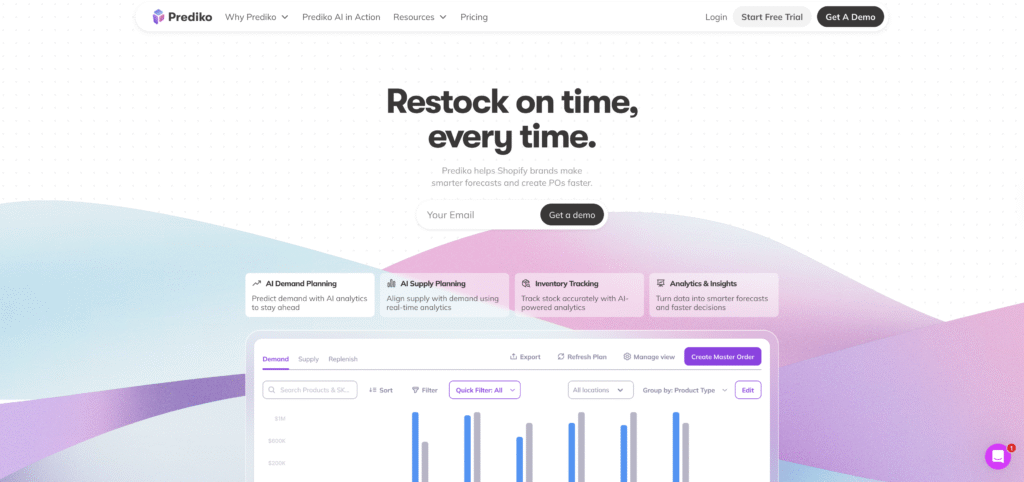
Why it matters for ecommerce: Overstocking ties up cash. Stockouts lose sales. Prediko uses AI to forecast demand with 30-50% higher accuracy than traditional methods, helping you order exactly what you’ll sell.
Prediko is trusted by 1,000+ Shopify brands. It analyzes historical sales, seasonality, market trends, and supplier lead times to predict future demand at the SKU, product, and category level. Real-time alerts notify you when to reorder.
Key Features for Ecommerce:
- SKU-level demand forecasting (accurate down to individual products)
- Seasonality and trend detection (automatically adjusts for holidays, promotions)
- Real-time stock health monitoring with proactive reorder alerts
- Multi-warehouse and multi-supplier support
- Customizable inventory reports (100+ filter options)
- Predictive restock recommendations with confidence levels
Pricing: Custom pricing (enterprise). Typically $300-$2,000+/month depending on catalog size and feature set. Trusted by 1,000+ Shopify brands.
Free Plan: No formal free trial, but demos available.
Real Impact: AI inventory management reduces holding costs by 15-25% while reducing stockouts by 40-60%. One retailer cut inventory levels by 20% while improving service levels by 65%—the same stock was working harder. Automated purchase order generation saves 8-12 hours/month of manual work.
Best for: Stores with 500+ SKUs, multiple suppliers, or complex inventory (e.g., multi-warehouse, multi-location). If you’re regularly overstocked on some items and out of stock on others, this tool directly improves your margin.
>> Manage Your Inventory with Prediko <<
ROI Breakdown: What You’ll Actually Save
Here’s the math for a typical small ecommerce store:
Scenario: $500K Annual Revenue Store (25 orders/day)
| Tool | Implementation Cost | Monthly Cost | Time Saved/Month | Revenue Impact | Payback |
|---|---|---|---|---|---|
| Tidio | $0 | $29 | 40 hours (support) | 12% conversion lift = +$5,000/month | <1 month |
| Pricing.AI | $0 | $10 | 20 hours (manual pricing) | 8% margin increase = +$3,300/month | Immediate |
| Shopify Flow | $0 | $0 | 60 hours (order/inventory tasks) | Reduced errors = +$2,000/month | Immediate |
| Jasper | $49 | $69 | 30 hours (content creation) | Faster product launch, better SEO | 2-3 months |
| Total First Year | $0 | $108/month | 150 hours saved | +$10,300/month incremental | < 1 month |
This assumes modest, conservative impacts. Many stores see 2-3x these numbers.
Success Stories: How This Works in Practice
Avanchy (Baby Products Brand): Installed a product recommendation app within Shopify. Result: 73% revenue increase in 30 days, driven entirely by higher average order value as customers discovered complementary products.
ATMDX (Therapeutic Wellness Brand): Migrated to Shopify 2.0 with AI-enhanced product search, recommendations, and personalization. Result: 150% sales growth, 7x conversion rate improvement (1% → 7%), 90% faster page load times, all within 90 days.
Christy Ng (Jewelry Brand): Implemented Shopify Flow for order processing automation and multi-location inventory sync. Result: 400% year-over-year revenue growth, order processing reduced from 2 days to 1 hour.
These aren’t outliers. They’re typical results when automation is deployed strategically.
How to Start: A Step-by-Step Implementation Roadmap
The most common mistake is trying to automate everything at once. Instead, follow this low-risk, high-confidence path:
Step 1: Identify Your Biggest Bottleneck (Week 1)
Ask yourself: Where am I personally spending the most time or losing the most revenue?
- Support emails piling up? → Tidio Chatbot
- Inventory mismanagement or stockouts? → Shopify Flow + Prediko
- Low conversion rates or low AOV? → Nosto or Pricing.AI
- Content overwhelm? → Jasper
Pick one problem. Not five.
Step 2: Test on a Free or Low-Cost Plan (Week 2-3)
Most tools offer free trials or free tiers. Use them for 2-4 weeks:
- Pricing.AI Free: Set up 3-5 pricing rules, monitor performance
- Shopify Flow Free: Create one automated workflow (e.g., cart abandonment email)
- Jasper: Write 3-5 product descriptions, get feedback from team
- Tidio Free: Let 50 chatbot conversations run, measure conversion lift
Don’t worry about perfection. You’re testing whether the tool solves your problem.
Step 3: Measure Before and After (Week 3-4)
This is critical. Without baselines, you can’t judge ROI.
For support automation: Track response time, resolution rate, customer satisfaction scores before and after.
For pricing automation: Record margin/revenue before pricing rules activate, then after 2 weeks.
For inventory: Count hours spent on manual checks, note stockout/overstock frequency.
Step 4: Decide, Commit, Scale (Month 2)
If your pilot shows positive results (which most do), upgrade to the paid plan and expand the workflow.
- Add more support topics to Tidio
- Create additional pricing rules in Pricing.AI
- Build 2-3 new Shopify Flow automation
- Train your team on the new process
Step 5: Monitor Monthly, Adjust Quarterly (Ongoing)
Set a calendar reminder: first Friday of every month, review performance.
- Is the chatbot resolution rate staying above 70%?
- Are prices competitive and margins healthy?
- Are there new workflows worth automating?
Adjust triggers, rules, and thresholds based on data. What works in January might need tuning for June.
Common Pitfalls and How to Avoid Them
Pitfall 1: Over-automation removes the human touch.
Fix: Automate routine work, but keep humans in the loop for complex or high-value interactions. Flag VIP customers for manual support. Review automated emails quarterly to ensure tone is still warm.
Pitfall 2: “Bad data in, bad data out”—messy product data ruins recommendations.
Fix: Before activating recommendations or inventory forecasting, spend a week cleaning your product data. Ensure consistent titles, descriptions, tags, and pricing. This single step improves AI accuracy by 50%+.
Pitfall 3: Setting up automation, then ignoring it.
Fix: Automation isn’t “set and forget.” Monitor weekly for the first month, then monthly thereafter. Check conversion rates, error logs, customer feedback.
Pitfall 4: Too many tools creating chaos.
Fix: Consolidate. Use Shopify Flow for workflow automation (it’s free and native). Pick one recommendation engine, one chatbot, one pricing tool. Avoid the trap of subscribing to 10 different AI tools—you’ll spend more time managing them than gaining from them.
Pitfall 5: Ignoring privacy and compliance.
Fix: Ensure all tools comply with GDPR (EU), CCPA (California), and local privacy laws. Read their privacy policies. Anonymous/aggregate customer data when possible. Document data handling in your own privacy policy.
Recommended Setup for a $500K Store
If you’re operating a small ecommerce store ($300K-$1M annual revenue) with 1-3 team members, here’s the stack I’d recommend:
Essential (start here):
- Shopify Flow (free, native)
- Pricing.AI or Intelis (dynamic pricing)
- Tidio or Gorgias (customer support)
Add after 3 months (once basics are running smoothly):
- Nosto or Clerk.io (product recommendations)
- Klaviyo (email marketing + AI segmentation)
Add after 6 months (when you have cash from improved margins):
- Jasper (content automation)
- Prediko (inventory forecasting) — only if you have 500+ SKUs
Total monthly cost: $42-$150/month depending on scale and tool choices. Expected first-year ROI: $5,000-$15,000+ (conservative estimate).
Frequently Asked Questions
Q1: Will AI automation make my store feel generic or impersonal?
Not if you do it right. Train your chatbot on your brand voice. Set pricing rules that reflect your values (don’t race-to-the-bottom). Review recommendations before they go live. AI amplifies authenticity; it doesn’t create it.
Q2: I only have 50 products and 100 monthly orders. Is automation worth it?
Yes. Even if you only save 2 hours/week, that’s $4,000+/year in labor freed up. At that scale, Shopify Flow (free) + Pricing.AI (free tier) + ChatGPT ($20/month) is a $20/month investment for 100+ hours of annual time savings.
Q3: What if the AI makes a mistake?
It will. Build in safeguards: price floors, manual review of high-value orders, fallback rules (“if chatbot can’t resolve, escalate to human”). Start with low-impact automation (email subject lines) before high-impact (price changes). Monitoring prevents small mistakes from becoming big problems.
Q4: How long does implementation really take?
For a single tool on a small store: 1-2 weeks from decision to live. For a complete stack: 6-12 weeks to have everything tuned and producing results. Most gains appear in the first 4 weeks.
Q5: Do I need a data scientist or developer?
No. All the tools in this guide are designed for non-technical users. Shopify Flow uses drag-and-drop logic. Pricing.AI uses rules, not code. Lyro is pre-trained for ecommerce. You need curiosity and patience, not technical skills.
The Bottom Line: Start Today, Not Tomorrow
In 2025, 51% of ecommerce businesses are already using AI automation. The gap between leaders and laggards is widening. But here’s the good news: you don’t need a massive budget to start.
$42/month for a chatbot. Free pricing rules. Native Shopify automation at no cost. These tools are more accessible than ever.
Your competitors are likely already using them. The question is: when will you?
Your next step:
- Identify your biggest bottleneck (this week)
- Sign up for a free trial or free plan (this week)
- Run a 2-4 week pilot (next month)
- Measure the results (end of month)
- Decide to scale or optimize (if ROI is positive—and it will be)
That’s it. You don’t need permission, a big budget, or a technical team. Just a clear problem and willingness to test.
The stores winning in 2025 aren’t smarter. They’re just automated. Now, it is your turn to join the game in 2026.